By Abby Lass
Editor-in-Chief
It’s no secret that there are problems with the Signs of Suicide (SOS) Prevention Program.
Like many of the other health videos that students are subjected to throughout their middle and high school years, it features overdramatic actors in stale scenarios, overly sensationalized stories, and cookie cutter classifications for people who might be at risk.
But even more so than what is discussed in the video, the fact that so many topics are left out is what is truly life threatening.
Not once in any part of the SOS curriculum does it mention mental disorders like anxiety, which is three times more common among the general population than suicidal tendencies (thekimfoundation.org), nor does it clarify that a person can be depressed without being suicidal, a huge disservice to the 20% of teens who are dealing with the disorder.
To be fair, basic mental health comprehension is not SOS’s goal, and that’s fine. Unfortunately, though, SOS is not simply one part of a multifaceted curriculum about living with mental illness; it is a single program that takes place in a single day, and the rest of South’s health curriculum isn’t picking up with slack.
In an independent survey conducted by Newton South students, 60% of the 108 students surveyed said that they had no memory of learning about mental health during their freshman year, the only year in which students receive a substantive wellness curriculum based on classroom exploration instead of physical exertion. This means that the only glimpse that many students will ever get into the world of mental illness is one in which people’s lives are hanging by a thread.
This, to be blunt, is just as ludicrous as teaching about the principles of Islam by watching videos about ISIS or claiming to understand the Republican Party’s goals after going to a Trump rally. It’s warped, it’s ineffective, and it’s down right dangerous.
What this suicide-centric agenda does is create an incredibly skewed perception of what it means to live with a mental disorder while simultaneously belittling those that are trying to do so.
According to the Center for Disease Control, 38,000 people die of suicide in America every year. This number is horrifically high, but by no means does it reach even a fraction of a percent of the total number of people living with a mental disorder in the United States, a number that reaches upwards of 80 million individuals.
There are millions of people surviving and thriving with these neurological abnormalities, either on their own or with the assistance of therapy or medication, but Newton’s current health curriculum leaves them all in the shadows. The lens through which our schools deal with mental health puts a diagnosis of OCD on the same level of severity as a trip to the ER after a suicide attempt because we have wrongfully learned that to have a mental disorder is to constantly be spiraling out of control.
By constantly reminding myself that it could be worse, I and many of the other students in my position are diminishing our struggles and turning them into non-issues, which means that we might be hesitant to ask for the help that we genuinely need.
This makes the decision to even receive a diagnosis, something that can open doors and provide a better understanding of oneself, incredibly stressful for students and their families. They worry about what it will mean, what will be read into the fact that they or their child attends therapy or might need some extra help to get through the day.
Conversely, by leaving out any mention of mental illnesses unrelated suicidal tendencies, the curriculum diminishes the impact of other mental health conditions that are not immediately life-threatening because it does not deem them important enough to talk about.
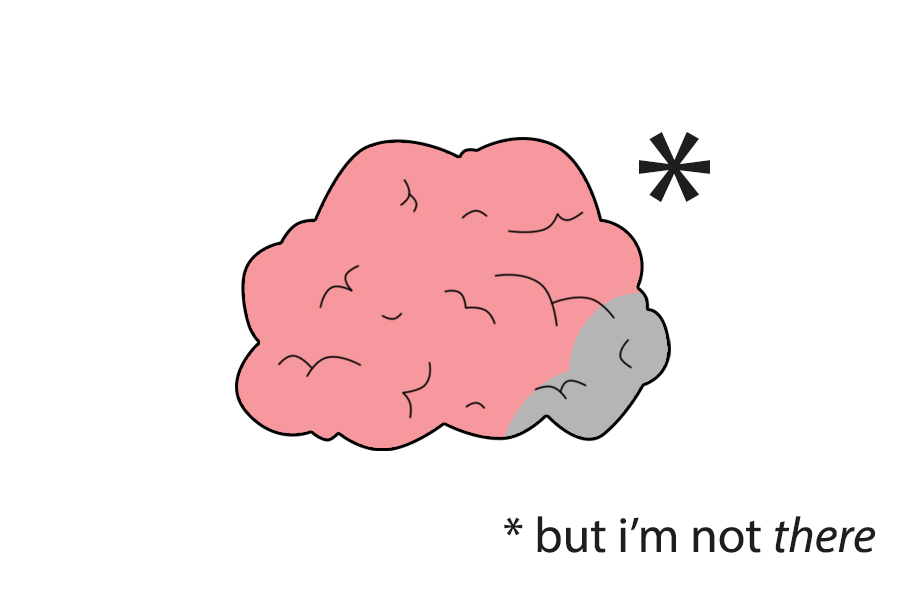
When I want to talk about my life with a mental disorder within our community, I constantly feel forced to add a quick “but I’m not there” at the end of every sentence: I can’t sleep, I’ve pulled out one of my eyebrows, and I don’t want to talk to any of my friends, but don’t worry, I have no intention of killing myself– I’m not there.
This caveat, while reassuring to loved ones, shifts the conversation away from the issue at hand. My problems are real and my concerns are valid, whether or not I have any intention of killing myself. I may not be there, but I am here, and being here deserves just as much compassion and understanding as being anywhere else does. But by constantly reminding myself that it could be worse, I and many of the other students in my position are diminishing our struggles and turning them into non-issues, which means that we might be hesitant to ask for the help that we genuinely need.
Left without options, many students turn to the internet for advice and information. While this decision can open students up to the dangers of misinformation, it is also incredibly isolating.
The moment when you stumble upon a term that clarifies everything you’ve been struggling with for months is an incredibly validating one, but all too often the next step remains unclear. How do you explain these discoveries to your friends, your parents, to the adults that will immediately scoff at your findings because they are based on an online test that clearly says it should not be used as a diagnostic?
Once again the words are in our mouths and we have no way to use them, no way to make people understand what we’re dealing with.
The only way to allow us to use these words, to help us understand the realities that we and many others like us are facing, is to treat mental health issues like the important but everyday topic that it is.
Maybe you’re against this because you’re scared of excessive diagnoses and medication or of glorifying disorders like self-harm and anorexia, and you’re right to worry; those are both real issues as well. But the only way to beat the idealized fantasy of a beautiful teenage girl puking into a toilet to stay on the cheer team or the stigmatized illusion of a young man who can’t function in society because of his disorder is to provide diversified information, plain and simple.
In the same independent survey, 89% of responders stated that they knew at least one person who had been diagnosed with a mental disorder. Suicide is a serious issue, but it is not the only issue. People with mental illnesses are everywhere, and we often do not look like the picture you have of us in your head. We need comprehensive curriculum reform that covers a much broader scope of mental health issues. This can come in the form of a more expansive SOS program or simply from increased attention during freshman year– all that matters is that we don’t wait around for someone else to make it happen.
Everyone deserves to be able to understand who and why they are, to know that they are not alone and that no matter what the chemical makeup of their brain looks like, they have a future full of love and happiness and success.
Let’s make sure we all learn that sooner rather than later.
The opinions expressed in this article reflect the views of a single party and are in no way representative of the stance of this publication.