By Dan Rosenzweig-Ziff, Sam Rosenblatt & Jake Epstein
Editor-in-Chief, Managing Editor of Sports Vol. 55, Sports Reporter
It’s a regular Wednesday during the spring sports season. One student has a test and quiz tomorrow, while another has a huge paper and a project. They hope that they’ll have the time and energy to study for the exams or put the finishing touches on their paper, but they know that this will be a challenge; they have an away game at Westford at 4 p.m.
The student-athletes will miss their last class of the day and hopefully get back to South by 8 p.m. – if they’re lucky. Then they’ll have to shower and eat dinner and before they know it they’ll be exhausted, starting their homework at 9 p.m. or later.
The thought of studying or working on a paper with intense focus seems impossible.
South’s student-athletes know this scenario all too well because this schedule could be a weekly occurrence as members of the Dual County League (DCL). While some schools in the DCL are just a few miles away from Newton South (Weston, Waltham, Boston Latin) others can take up to an hour or longer to travel to in heavy traffic (Acton-Boxborough, Westford, Bedford, Lincoln-Sudbury, Concord-Carlisle).
So how did South end up in this spread out DCL, while much closer schools like Needham, Brookline, Wellesley and even Newton North all play in the Bay State Conference (BSC)?
Both the DCL and the BSC is composed of large and small school divisions based on student population:

Formation and League History
Back when South was just starting out, in the 1960s, the modern BSC, as well as the modern DCL, had not evolved yet. Instead, there was the Suburban League, made up of a mixture of what is now the Bay State and the Greater Boston League, in addition to Waltham. It was considered the most powerful league in the state, especially in football.
“It was big schools that were really powerful athletically, and we were just starting,” said Newton South basketball coach Joe Killilea, who has been at South and in the DCL for 39 years. “Brockton was killing everyone in football, like destroying them, which is why the league broke up.”
“Back in 1991 or ‘92, the Bay State Conference had some openings, and they were looking for two schools to come on board,” Newton North Athletic Director Tom Giusti said. “At that time, the league that we were in, which was the old Suburban League, kind of broke up – so Newton North and Brookline were accepted into the Bay State Conference.”
South, however, was a much smaller school than North and was still building up its athletics to try and compete on a state level. For its first few years, back in the ‘60s and early ‘70s, South played independently of any league before finally joining the DCL, which had within it a lot of similarly small-sized school.
“South was a small school then. We’ve gotten a lot bigger since then; we’ve grown a lot,” Killilea said. “When I started coaching we were Division 2. Now we are in the middle of Division 1.”
Joining a league is not as easy as it may seem, however, as it requires approval from a variety of officials.
“There has to be an opening in the league, and they have to accept you into the league,” current Newton South Athletic Director Patricia Gonzalez says. “So when the Suburban League disbanded, there were three schools– Brookline, Waltham, and North, that applied to the Bay State League. [Waltham went to the DCL].”
Even the organization that operates sports in Massachusetts, the Mass. Interscholastic Athletic Association (MIAA), has no jurisdiction over league assignment. According to Gonzalez, the MIAA only regulates the assignment of divisions – which are based on size and competitiveness (for state tournaments in each sport) – but not leagues themselves.
“I don’t know if the city of Newton wants both high schools playing in the same league. I think that actually has some validity to it.” – Former Newton South Athletic Director Scott Perrin
Approving a league change is not an easy task because when a single school or multiple schools leave a given league, it creates a problem for the remaining schools in that league. These remaining teams would consequently have trouble filling schedules because they would need to have more non-league games (having lost their league opponents).
“If we could cut down on the travel, it would be great, but it would have to start with some openings occurring in these leagues and then you have to get accepted by the current league,” Giusti said. “The Dual County League is a great league and our league [the Bay State] is a great league too, but I think you guys end up doing a bit more traveling.”
While the Bay State Conference catered to schools in the Greater Boston area, the Dual County League was formed to serve many regional high schools composed of two towns, such as Lincoln-Sudbury or Acton-Boxborough.
According to former Newton South Athletic Director Scott Perrin, many high schools came in and out of the DCL over the years. The league grew over the years to include schools as far away as Arlington and Tyngsborough, a town which borders New Hampshire.
Though the distance between some DCL schools is still daunting, Gonzalez says the like-mindedness of the schools makes for a quality athletic league, which was one of the primary reasons the league formed the way it did.
“The schools of the DCL had similar common trends [such as] the quality of education, the value that they put sports and academics, the facilities,” Gonzalez said. “The idea is always the matchup– the philosophical matchup, what the school stands for– and the academic part, and sports come with that.”
Distance’s Effect: BSC vs. DCL
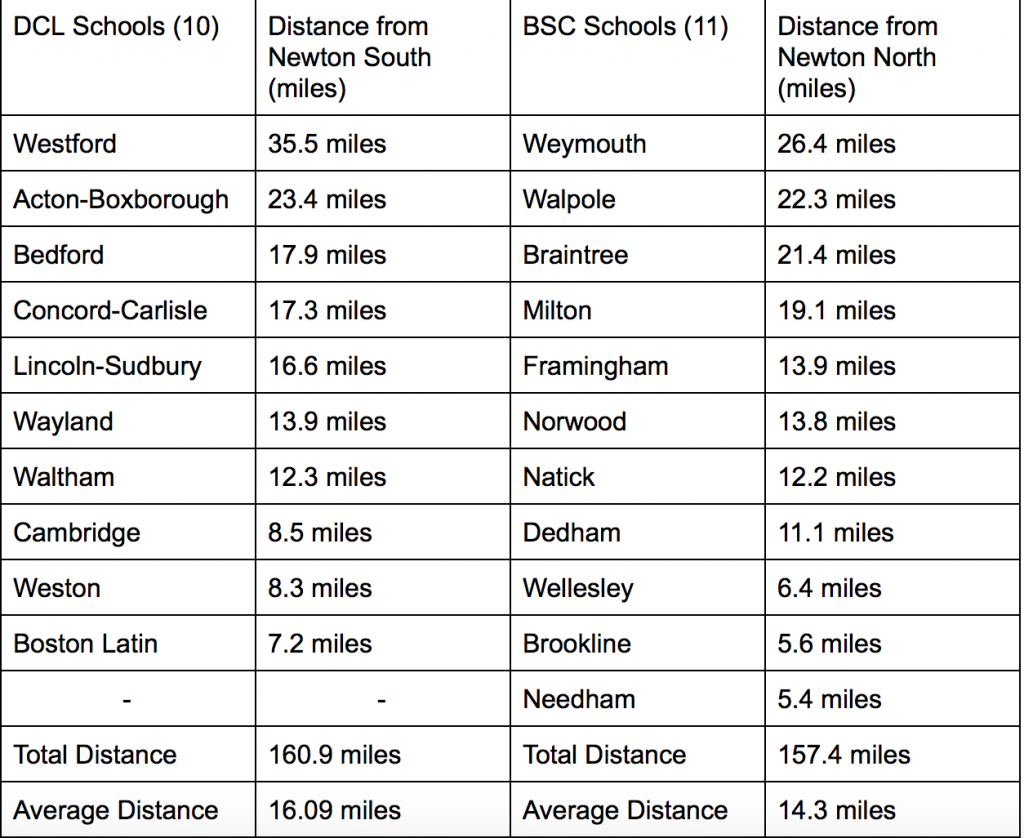
A trip to Westford Academy from Newton South covers 35 miles, making Wesford the school’s farthest opponent. While some players and coaches dislike the long bus rides, others are used to the travel time and enjoy what the DCL has to offer in terms of competitiveness.
“I’m very comfortable in [the DCL], so does it make sense to me? Yes. You know, do we take a lot of long bus rides? Yes,” Killilea said. “I don’t think there is any effect academically. [Having an away game will] have the same effect no matter the length of the bus ride.”
Although Perrin believes that the long travel time can affect students academically, he knows some students are able to rise above the challenge. “There are certain types of kids that have no problem; they can get their homework done on the bus rides and work it into their daily routine,” he said.
Senior soccer and lacrosse player Ava Shaevel has seen varying levels of school-work being done over the course of her South athletic career.
“When I was a freshman I used to do homework on the bus, but I don’t think I have since freshman year and I don’t really see it being done [now],” Shaevel said. “I think the long bus rides probably prevent people from doing homework because usually it is a time to socialize or get pumped for the game, so not a lot of homework is getting done, which is understandable because people are trying to get into the zone.”
“It’s not ideal, that’s why my hat is off to all our student-athletes,” Gonzalez said.
North, on the other hand, feels closer to most of their opponents, according to Giusti.
“I think Newton South does a little bit more traveling,” he said. “For us, it’s right up or down Route 128. The schools that we play are right off the highways, so it’s almost like a ‘128 League’ or a ‘Route 9 League’ when you look at Natick and Framingham.”

While for the most part the traveling doesn’t feel as bad for North, Newton North senior basketball and volleyball player Nate Hollenberg says there are still times when the travel is difficult.
“Braintree and Weymouth. When you realize you have a game at Weymouth on a Tuesday night, you get home at 10:30 p.m., like that’s crazy,” Hollenberg said. “I guess it’s kind of necessary, but it could easily be avoided if you make leagues localized. I’d love it if Cambridge, South, Wayland, Weston, Wellesley, Needham, Brookline were all in the same league – there’s easily enough schools around to make a league.”
When Perrin was the AD, he made attempts to move South of the DCL to cut down the mileage while retaining the great competition.
“Four or five years ago as athletic director, I began to explore possibly leaving the Dual County League,” Perrin said. “We were looking at the Bay State Conference as a place to land. There were a series of meetings, and it actually never came to fruition for multiple reasons.”
According to Perrin, a mix of DCL and BSC schools had been looking to switch leagues at the time. Some changes have come into action, such as Dedham’s recent decision to leave the BSC for the Tri Valley League in the 2017-18 school year.
“There was a proposal to either form an independent league, which would kind of keep [South] away from playoffs and league championships,” Perrin said. “Then there was a possibility of – I wanted to move Newton South to the Bay State Conference.”
“I thought that would have been a better move,” Perrin said. “Framingham and Weymouth provide long travel as does Westford and Acton, but not as much on a consistent basis.”
However, Perrin thinks the travel issue in general extends further than just the Dual County League. “I think the state really needs to examine all of the leagues,” he said. “With fuel costs at what they are, time constraints and everything else, the state really needs to come in and place teams in geographical areas where it’s close to travel and they can go back and forth.”
Gonzalez agrees with Perrin’s view on travel costs. “As much as transportation affects [student-athletes], it affects the budget too. We’re cognizant of that,” Gonzalez said. “In the scheme of things, I think the DCL is a great option for the athletes– the downside is the transportation.”
“The Dual County League is a great league and our league [the Bay State] is a great league too, but I think you guys end up doing a bit more traveling.” – Newton North Athletic Director Tom Giusti
After South’s potential move to the BSC garnered momentum, Perrin began to experience resistance. “The problem was due to the size of our school, we were going to potentially have to bump one of the Bay State Conference large schools into their smaller division,” he said.
“The resistance picked up, I think internally, within the city that, ‘Let’s not do this because it’s not going to create a good situation for both high schools to be in the same league, competing for the same athletes,’” Perrin said. “I think that’s something that was probably driven by the North side of the city, but that’s where it is and that’s where it ended.”
The Cross-City Rivalry: What does the city of Newton want?
While Newton North and Newton South remain in different leagues, the Tigers and Lions have built up traditions of facing off in scrimmages or non-league games.
The South football and boys’ hockey teams traditionally compete against North in scrimmages prior to the start of the regular season. The Newton baseball, field hockey, tennis, and lacrosse teams meet annually during their seasons and the softball and boys’ volleyball teams have drawn each other in the playoffs this past year.
“When North and South play each other it’s a great community event,” Giusti said. “[The games are] always well attended, lots of emotions. [But] win, lose, or draw, everyone still remains friends afterwards.”
One of the most riveting instances of this cross-city rivalry was South’s come-from-behind, 3-2 victory over North in the 2015 boys’ volleyball sectional semifinal. The Lions trailed 2-1 after three sets, before rallying to win the final two sets.
Another thrilling matchup was the Lions’ 74-67 victory in boys’ basketball over the Tigers during Christmas vacation this past year.
“You always want to play your cross-town rivals and be the king of the city. I feel like if you’re not going to be in the same league you should schedule a game every year to make sure you play.” – Newton North senior athlete Nate Hollenberg
Both schools play teams from all over Mass. and travel about 160 miles in total within their respective leagues, but putting them in the same conference has always been a point of debate.
“I don’t know if the city of Newton wants both high schools playing in the same league,” Perrin said. “I think that actually has some validity to it.”
Many are afraid that if both high schools in Newton were in the same division, the part that Giusti loves – the part where everyone at North and South is still friends when the game ends – would slip away and a bitter rivalry would develop. Fan sections would get too rowdy and friendships would end.
“I think it’s understandable [to have North and South in different leagues] because we used to play North in soccer and the last game we played against them like three girls tore their ACLs and it got extremely heated,” Shaevel said. “I think that mentality of supporting hurting people and not playing to win is kind of what the game brought. I think if there is a way to make it so people play just to win only then it’d be a good idea to play each other.”
“The decision was made many years ago about not having both schools in the same conference so you don’t go head to head, so it’s not that kind of competition. We like to play each other, we try to have games at the beginning of the season, sometimes scrimmages against North, but the conference is not at stake.,” Gonzalez said. “I think that’s a philosophical stand that the district took in that regard many years ago and many ADs ago in both schools.”
While the ADs focus on having less significant games occur between the two schools early on in the season, students still find the atmosphere of playing the cross-town rival different than any other game. Athletes can expect a large fan section from both schools at many head-to-head events, no matter when in the season.
“I think it is actually different; it’s a little bit more heated because you personally know the girls on the other team and they’re from the same city as us,” Shaevel said. “So we want to win obviously because we don’t want to look like the bad Newton team.”
For Hollenberg, after playing in highly competitive and spirited matchups against South, playing the cross-city rivals is always a season highlight.

“Personally, I love playing South because I’ve been playing against or with these kids my whole life. It’s always fun knowing the person you’re guarding, but this year in volleyball we didn’t get to play South, and I feel like that should never happen,” Hollenberg said. “You always want to play your cross-town rivals and be the king of the city. I feel like if you’re not going to be in the same league you should schedule a game every year to make sure you play.”
“When you look at the level of competition, it’s not always fair, so as athletic directors we’ve had some discussion about that,” Giusti said. “There have been times where [we’ll ask] would Newton South be interested? I said, ‘They have close ties with the Dual County League.’ As far as that decision, that would have to be a community and maybe even a superintendent [decision].”
Newton Public Schools Superintendent David Fleishman has not been involved in any talks about South switching leagues. However, he does see both the benefits and concerns of competition between Newton’s high schools.
“I’ve certainly been to exciting games between Newton North and Newton South,” Fleishman said. “I think the feeling of the athletic directors is that it’s healthier if they are in separate conferences. That’s my sense.”
Fleishman acknowledges that any realignment with both schools would require his involvement.
“Usually athletics are handled at the school level, but I see how this is more of a district decision or conversation because it really involves both high schools,” he said. “I don’t think South can make a decision without partnering with North.
Giusti also sees the community aspect of an ongoing North-South matchup.
“I get it from the fan’s [perspective], [North and South being in the same league] would be terrific. Everybody grows up together playing on all of these teams,” Giusti said. “As long as everything is kept in perspective, I think it would be lots of fun and create great memories.”

Fleishman agrees with Giusti and is also open to the idea.
“I’m open to talking to the school principals and athletic directors about it,” Fleishman said. “It’s not a decision I would ever make arbitrarily on my own without lots of consulting, because I think this is a community decision and athletics really are community events.”
“I think it’s always good to have a little rivalry. I think that the more sports games that would get played, the rivalry wouldn’t get worse, it would get better,” Hollenberg said. “Now when we don’t play each other in sports there is a lot of speculation, like North is way better at sports or South is way better at sports, but there’s no way to actually know unless you play. It’s like a Newton event when the two teams play and it can bring the town together.”
Currently, however, the two schools will not meet with a league title on the line anytime soon, as both schools and their ADs and coaches are content to stay in their respective leagues, which despite the travel, constitute two of the most competitive leagues in the state.


* denotes Super Eight victory
^ South and North have had a co-op boys’ gymnastics team since the 2014-15 season
A denotes All-State championship
AS denotes both State and All-State championships
NOTE: Cambridge joined the DCL in 2014-15, so previous titles are not listed
The DCL and all its Glory
“The DCL is one of the best leagues in the state,” Killilea said. “In basketball, we had the Division 1 champ, the Division 2 runner up. Bar none, we were the best basketball league in the state, bar none. You earn it when you are a league champion across all sports.”
At the end of the day, the DCL is known around the state for being one of the most competitive across multiple sports, but that is not all it is known for.
“The DCL was the first league to have such very high standards about sportsmanship. It was really started by a former AD here,” Gonzalez said. “At that time, there were many things that were happening in our sports that were really red flags. The way the players were treating each other, the way the fans were treating each other, so they created a code of conduct that has been the example for the state.”
Each season, the DCL gives out its sportsmanship award to a team that displays a level of fairness, ethics, and respect that goes above and beyond. As Gonzalez says, the DCL places its emphasis not only the quality of its competition, but on the importance of being a good teammate, of being a respectful opponent, and, of course, on being a successful student.
As seen in the chart above, the DCL has won 48 divisional and state championships among 11 schools while the class of 2016 has been in high school, giving it 10 more than the BSC among its 12 schools in the same time span. The teams compete across all sports and divisions, which gives coaches like Killilea a certain comfort in the league’s current alignment.
“You know the coaches, you know the administrators, most of the coaches have been around for a long time. I love it – it’s really good people,” Killilea said. “[I root for other DCL teams] all the time. You get to be friends with the coaches, you get to know the kids. You build relationships.”
According to a US News ranking, six of the 11 DCL schools ranked in the top 50 schools in MA.
“You’re not going to find better schools. All of the Dual County League schools are as good or better than we are [academically],” Perrin said. “We love to hang our hat on academics, but Lincoln-Sudbury is a damn good academic institution, so is Acton, so is Latin.”
At the moment, Gonzalez thinks that one of the biggest challenges isn’t the distance between South and any other school, but getting the South fan section out to support their peers.
“We need to find a way to get the students out when we play at home. If they are not willing to come [to home games] to support their team, it doesn’t matter who you play against, they’re not going to travel,” she said. “The reality is sometimes when teams are very successful and when they get into the tournament, people will follow. And it doesn’t matter how far you play, they will follow.”
As the DCL has grown over the years to be what it is now – a powerhouse of a league that prides itself on academics and sportsmanship – coaches, players, and administrators alike have found the traditions the DCL has cultivated to further the meaning of competitive sport.
“It’s by far the most competitive league in the state for almost every sport there is. That’s what makes it great,” Perrin said. “If you want to be the best, you’ve got to play the best.”
“For our weaker teams, it’s an opportunity to see what you’re up against, and see where you need to be to really be good and successful,” Perrin said. “And for our teams that compete, it’s the right league.”