
By Rachel Honigsberg
Imagine stepping off a plane and immediately being immersed in a new culture that you will live in for several months.
Each year, this seemingly daunting task is embraced and highly-anticipated by the students participating in the Newton-Beijing Jingshan Exchange Program.
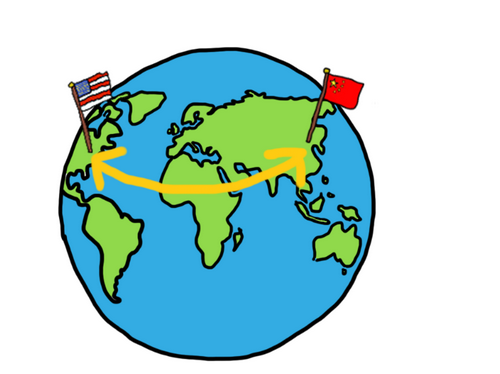
The program, which began in 1979, allows students from the Jingshan school in Beijing to live in Newton for four months in the fall. Afterwards, Newton High School students to travel to Beijing for four months to take classes entirely in Chinese (Mandarin) and have the opportunity to travel throughout China.
The Jingshan students just left Newton to return home, and the Newton students are currently in Beijing celebrating the Chinese New Year.
Simon Shen, a Jingshan exchange student feels that the Jingshan school is more academically rigorous than Newton South.
“There is less pressure in U.S. and a lot less work,” Shen said.
The Jingshan students also felt that the schedule at South is less intense and gives students more flexibility than that at the Jingshan school.
“In China, there are no electives and no free blocks…[and] class is never too easy,” Shen said. “There is not much time to hang out with friends.”
For the Jingshan students and students throughout China, the National Higher Education Entrance Exam commonly known as the “Gaokao” is a source of tremendous stress during their years in high school.
This exam determines which universities students in China are accepted into. Although it may seem comparable to the United States’ infamous ACTs and SATs, according to a New York Times article from last year, more than 9 million Chinese students take the Gaokao each year as opposed to just 3.5 million American students who take the ACTs and SATs combined.
“The Gaokao is the most important test,” Shen said.
For Newton students travelling to China, the culture of respect and how respect is expressed in China came as a surprise.
“You just don’t sit down when you are on the train,” former Newton exchange student Andrew Cheung said. “Even if there is a seat, you would have to stand right back up because the seats are in unspoken manner reserved for elderly, whereas in the U.S. it is more like ‘first come first served’.”
South senior Jack Rabinovitch, who travelled to China with the exchange program last year, found it in interesting that in China “you wouldn’t tell someone they are wrong directly.”
Jingshan student Annie Hu noted how her school is much smaller than Newton South and the hallways are narrower because the teachers walk from class to class, giving the students relaxing breaks between classes.
Rabinovitch feels that this schedule in which students stay with the same classmates throughout high school leads to more friendships within the classroom.
Despite these cultural differences, when it comes to spending free time the Jingshan students are just like any American student.
“After school I go around town with my friends,” Hu said.


